

Here's the truth most painting contractors won't tell you: the paint brand matters far less than how well the surface was prepared before it went on. You can apply $100-per-gallon Sherwin-Williams Emerald on a wall that wasn't properly cleaned, sanded, and primed, and it will peel in three years. You can apply a mid-range product on a perfectly prepped surface and it will last a decade.
At Paint Gunners, we spend 40-60% of every project on preparation. That's not an accident — it's the single biggest differentiator between a paint job that lasts and one that doesn't.

What Happens When Prep Is Skipped
Peeling and bubbling — Paint applied over dirty, chalky, or loose surfaces can't bond properly. It lifts within 1-2 years, especially on exteriors exposed to our Pacific Northwest moisture cycling.
Cracking at joints — Uncaulked gaps between trim and walls crack as the house expands and contracts with temperature changes. Water infiltrates through these cracks and causes damage behind the paint.
Uneven coverage — Bare patches, stains, and repaired areas that weren't primed will show through the finish coat. You end up seeing every patch and every repair through the final color.
Early fading — Surfaces that weren't cleaned of mildew or chalking will cause the new paint to degrade from underneath, fading unevenly.
What Professional Prep Looks Like
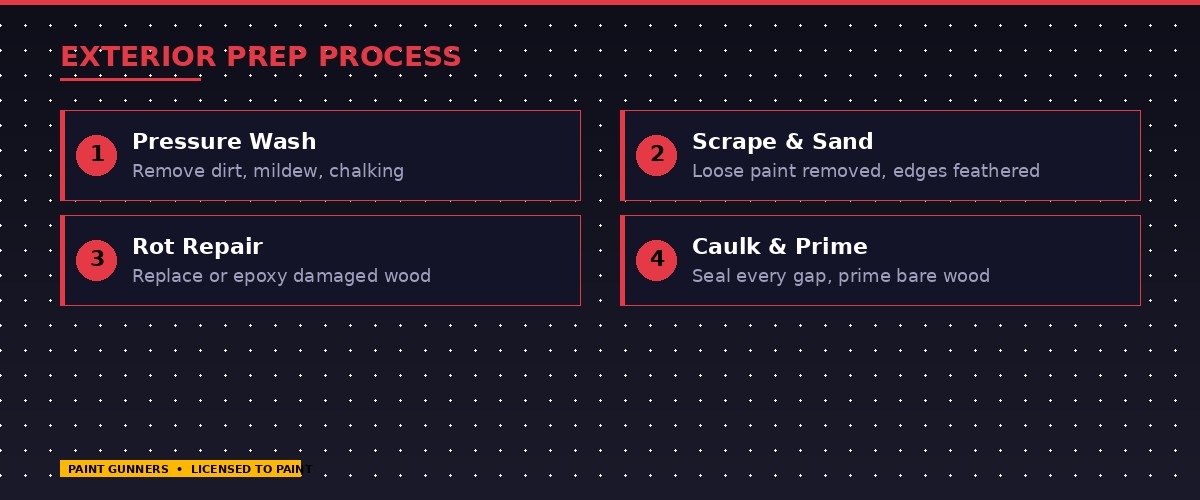
Exterior projects: Pressure washing all surfaces. Hand-scraping any loose or peeling paint. Sanding rough spots smooth. Inspecting for and repairing wood rot. Caulking every seam, gap, and joint around windows, doors, and trim. Priming all bare wood, stains, and repaired areas. Protecting landscaping, walkways, and adjacent surfaces.
Interior projects: Filling all nail pops, holes, and dings with spackle. Sanding repaired areas smooth. Caulking gaps between trim and walls. Cleaning kitchen walls of grease buildup. Priming stains, bare drywall patches, and dark-to-light color transitions. Full floor protection and masking.
How to Tell If a Contractor Cuts Corners on Prep
Ask one question: "What percentage of the project time is spent on prep?" If the answer is less than 30%, they're cutting corners. If they can't answer specifically, that's even worse.
Also look at the estimate. Does it list specific prep steps? Or does it just say "prep and paint"? A detailed estimate from a professional contractor specifies exactly what prep work is included because prep is where most of the labor happens.
The Bottom Line
When comparing painting estimates, don't just compare paint brands and prices. Compare prep scope. The contractor who spends more time preparing your surfaces will deliver a result that lasts years longer — and ultimately costs less per year of protection.
Get your free estimate from Paint Gunners — we'll walk you through exactly what prep your project needs. Serving Lynnwood, Bothell, Kirkland, Bellevue, Redmond, and all of Western Washington.